Lot Traceability: What to Have Ready Before a Recall
No producer expects a recall: a faulty closure, a contamination, a labelling error. But if it happens, the questions come fast. Which batch is affected? Where did it come from? Which customers, stores and club members received it? Producers who can answer in minutes protect their customers and their reputation. Producers who need days of digging through spreadsheets don’t. This post covers good practice, not legal requirements; check what applies to your licence and products.
What traceability means
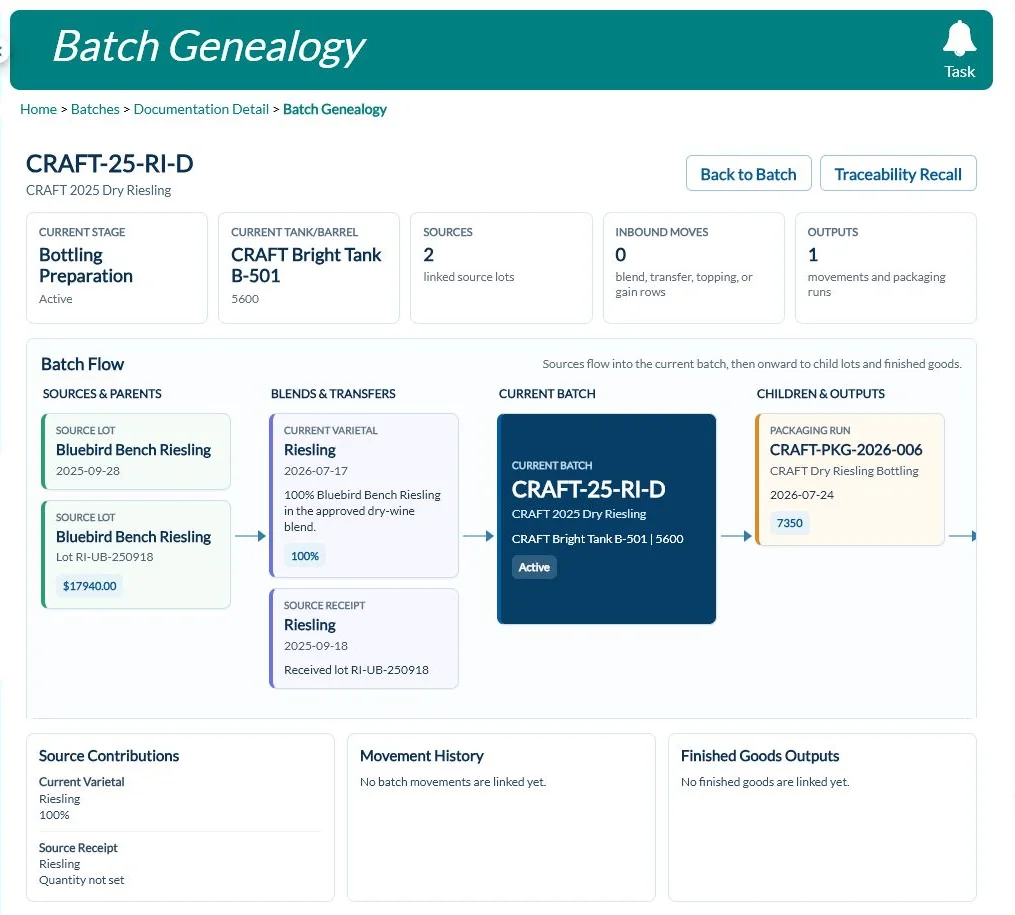
Traceability is the ability to follow any product backward to its sources, and forward to everyone who received it.
- Backward: this bottle, can or keg came from this packaging run, which came from this batch or blend, which came from these lots of fruit, grain or juice, from these suppliers.
- Forward: this batch went into these packaging runs, which were sold to these customers, shipped to these club members, and delivered to these stores.
1. Give every batch an identity
Every batch and lot needs a unique identifier from the moment raw ingredients arrive. When batches are blended or split, record the relationship, so the family tree is never lost.
Keep the format simple and consistent, for example the year, the product and a sequence number. Never reuse numbers, and don’t rely on vessel names alone: tank 4 held something different last month.
Make sure the identifier follows the product everywhere: on vessel labels, work orders, lab records, packaging records and, where possible, the finished package.
2. Record your sources
For each delivery of fruit, juice, grain or bulk product: the supplier, the date and the quantity, linked to the lot it became.
Record the supplier’s own lot or batch number as well. If a supplier ever recalls one of their ingredients, their lot number is what they’ll give you, and you’ll need to find where it went.
Do the same for the additions that often get forgotten: yeast, nutrients, finings, enzymes, flavourings and anything else that ends up in the product. Recording them as they’re used takes seconds; reconstructing them later takes days.
3. Tie packaging to batches
Every packaging run should record which batch it came from and create lot-numbered finished goods. If finished stock isn’t tied to a batch, the chain breaks at the most important point.
Record the packaging materials too: the lots of bottles, cans, closures and labels used. Closure and packaging faults are a common reason for pulling product, and knowing which runs used which materials narrows the problem fast.
If one batch is packaged over several days or in several formats, give each run its own lot number, so you can trace a problem to the right day and format.
4. Link finished goods to sales
Finished stock should move into the same inventory you sell from, so there’s one record of what you have and where it went.
The forward side of a trace is where most producers struggle. At the very least, record lot numbers on wholesale invoices, distributor shipments and large orders, because those are the customers you’ll need to contact first. For tasting-room and online sales, knowing which lots were on sale on which dates often narrows it down enough.
Keep customer contact details up to date, too. A trace that finds every customer is only useful if you can reach them.
5. Label vessels and keep records current
QR codes on tanks, barrels and kegs make it easy to record the right thing in the right place, and harder to log a reading against the wrong batch.
Update vessel labels every time a vessel is emptied, filled or moved, and make it part of the transfer routine rather than a separate job. Record transfers, blends and additions as they happen, by the person doing the work.
A quick weekly check helps: walk the cellar or brewhouse and compare what’s on each vessel with what your records say. Fix any differences straight away.
6. Practise once a year
Pick a random finished product and trace it both ways: back to its sources and forward to its customers. Time how long it takes. If it’s more than an hour, find the weak link before you need it.
Make it realistic. Pretend a customer has called with a complaint, and work out which records you’d need, who you’d call and what you’d say. Involve the people who would really do the work, not just the person who set up the system.
Write down what you found and fix it: a missing supplier lot number, a blend that wasn’t recorded, an account with no contact details. Then run the practice again next year and see how much faster it is.
What a trace looks like
Imagine a customer reports a problem with a can bought from your taproom. A good trace runs like this:
- Identify the lot from the can or the sale record.
- Trace back to the packaging run, then the batch, then any blends, then the raw ingredient lots and suppliers.
- Trace forward from the batch to every packaging run it went into, and from there to every sale: taproom, online orders, club shipments and wholesale accounts.
- Decide the scope: one packaging run, one batch, or every batch that used a suspect ingredient.
- Contact affected customers and accounts, using the customer records linked to those sales.
With connected records this takes minutes. With paper and spreadsheets it can take days.
Traceability gaps to fix now
- Blends with no record of their parts. If you can’t say which lots went into a blend, you can’t trace through it.
- Packaging runs not linked to batches. The most common break in the chain.
- Wholesale invoices without lot details. You know which store bought the product, but not which batch.
- Supplier lots not recorded. If an ingredient supplier issues a recall, you need to know where their lot went.
Traceability FAQs
Is traceability a legal requirement?
Requirements depend on your products, licences and where you sell. Check what applies to you. Good traceability is worth having either way, for quality control as much as recalls.
How far back should we be able to trace?
At least to the supplier lot of every major ingredient, and forward to every customer or account that received the product.
How long should we keep records?
Keep them at least as long as your products could still be on shelves or in cellars, and check any record-keeping rules that apply to your business.
Traceability pays off every day
Good traceability isn’t just recall insurance. The same records answer everyday questions: which batch a customer loved and wants more of, whether a quality issue is isolated to one packaging run, which supplier’s ingredients produce your best results, and what each batch really cost to make. Producers who keep connected records find they use them far more for quality and planning than for recalls, which makes the effort to set them up easy to justify.
How QUALO helps
QUALO Production records sources and receiving lots, follows batches through blends and transfers with batch genealogy, and puts QR codes on vessels and batches. Packaging runs create lot-numbered finished goods that move straight into sellable inventory, so every packaged lot traces back through each blend and transfer to its source.