Pre-Harvest Checklist: Getting Your Cellar and Data Ready
Once fruit starts arriving, there’s no time to fix systems. The weeks before harvest are when you decide whether crush runs smoothly or turns into a scramble of whiteboards and half-filled spreadsheets. Here’s what to get ready, in the cellar and in your records.
1. Know your vessel space
List every tank, barrel and tote, its capacity and whether it’s empty, full or needs cleaning. Map out which lots go where before the first bin arrives. Running out of tank space mid-harvest is expensive.
Look ahead at what will free up space: wines to bottle, rack or blend before harvest, and barrels to empty. Bottling a lot or two in August can make room for a whole block in September.
Check every vessel properly, not just on paper: valves, seals, cooling jackets and temperature controls. And plan for the unexpected. A bigger crop than forecast, or a grower with extra fruit to sell, needs somewhere to go.
2. Stock up on supplies
Check yeast, nutrients, additives, sanitizers, bins and lab reagents. Set reorder points on harvest essentials so you’re warned before you run low, not after. Order early: suppliers get busy too.
Build your list from last year’s usage, adjusted for this year’s expected tonnage. Check expiry dates on anything left over from last year, especially yeast and reagents, and store supplies where the team can find them at 6 a.m.
Don’t forget the small things that stop work when they run out: hoses, gaskets, clamps, gloves, picking bins and fuel for equipment.
3. Set up grower and source records
For every grower or orchard: contact details, contracted blocks or varieties, expected tonnage and pricing terms. When fruit arrives, you want to create the receiving record in seconds, not hunt for paperwork.
Confirm the details with each grower before harvest: how they’ll tell you fruit is ready, how deliveries will be scheduled, and how weights and quality will be recorded. Agree any quality standards, such as sugar levels or sorting, in writing, so there are no arguments at the crush pad.
If you’re buying from new growers this year, set them up now, while there’s still time to check details and ask questions.
4. Plan your receiving
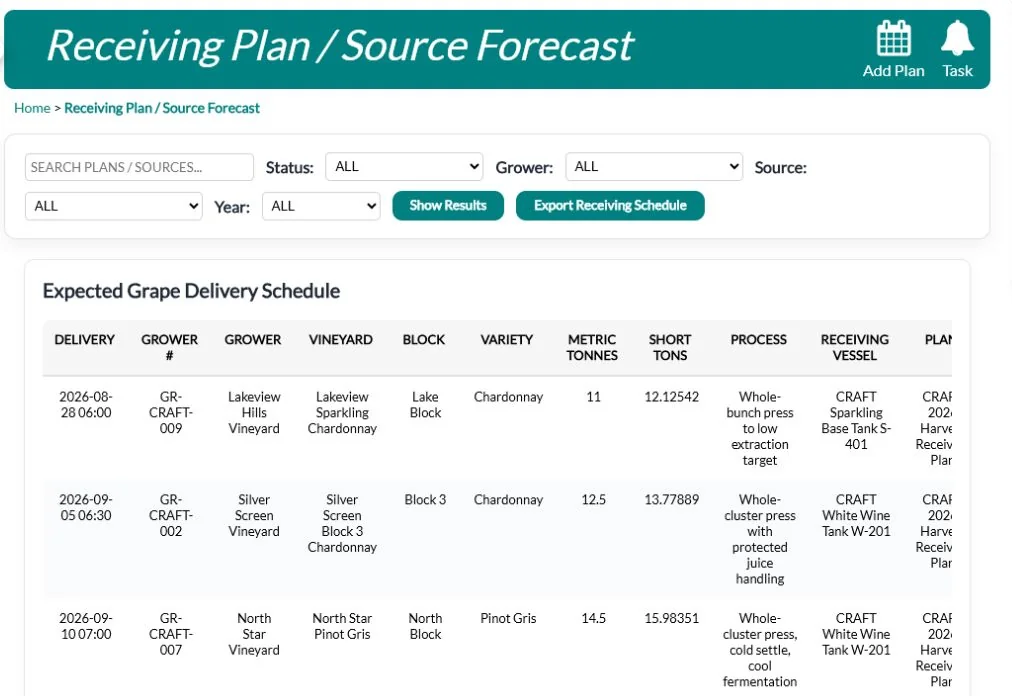
Build a receiving plan: which grower, which variety, which day, and which vessel it’s heading for. Decide how each load becomes a lot, so every batch starts with its source recorded and you can trace it all the way to the bottle.
Set up the receiving area itself: scale checked, sorting tables ready, and a clear place for trucks to unload and wait. Decide who records weights and sample readings, and how, ideally straight into your system rather than on paper.
Be ready to change the plan. Weather and ripeness rarely follow the schedule, so know which vessels you can switch to if a block arrives early or a load is bigger than expected.
5. Get the lab ready
Calibrate instruments, check reagent dates, and decide which readings you’ll record and how often. Consistent lab records during fermentation are what let you compare this vintage with the last.
Write a simple sampling plan: which readings for each lot, at what stage, and who takes them. Use the same units and methods every time, and record readings against the lot straight away, not at the end of the day.
If you send samples to an outside lab, check their harvest turnaround times and book ahead. Busy labs can be slow just when you need answers fastest.
6. Organize the team
Assign roles and shifts, and plan cellar work as work orders, so everyone can see what needs doing today and what’s done. Equipment maintenance before harvest, not during, saves breakdowns at the worst possible moment.
Brief the whole team before the first pick, including seasonal help: safety rules, sanitation routines, how to record their work, and who to call when something goes wrong. Long days and heavy equipment are a risky mix, so plan breaks and make sure nobody works alone on dangerous tasks.
Keep a list of service contacts for every key piece of equipment, and know who can fix the press on a Sunday.
7. Don’t forget the tasting room
Harvest often overlaps with busy tasting-room weekends and a fall club release. Make sure the front of house has what it needs to run without the winemaking team.
If you can, schedule the club release away from the busiest weeks, or have it fully prepared before the first pick. Keep tasting-room staff up to date on harvest progress so they can share the story with guests. Visitors love hearing about it, and some will want to see the crush pad.
Top up stock for the tasting room and online shop before harvest starts. Nobody will have time to move cases in the middle of crush.
A pre-harvest timeline
| When | Focus |
|---|---|
| 8 weeks out | Review last vintage’s notes; confirm grower contracts and expected tonnage |
| 6 weeks out | Order supplies; book equipment servicing |
| 4 weeks out | Clean and inspect tanks and barrels; plan vessel allocation |
| 3 weeks out | Calibrate lab equipment; set up readings and logs |
| 2 weeks out | Build receiving plans; set up grower and lot records |
| 1 week out | Team briefing; test the full receiving process end to end |
Harvest mistakes that cost the most
- Discovering a vessel problem on day one. A leaking valve or cooling fault is a small fix in August and a crisis in September.
- Paper receiving slips. Weights and grower details written on paper get lost or mistyped later, and grower payments depend on them.
- No lot plan. Deciding on the fly which loads go where makes blending decisions and traceability much harder later.
- Inconsistent lab readings. Different people, instruments or timing make fermentation data hard to compare.
- Forgetting the rest of the business. Club releases, tasting room weekends and wholesale orders don’t stop for harvest.
Harvest planning FAQs
When should we start planning harvest?
Two months out is ideal. Supplies, equipment servicing and grower contracts all have lead times.
How detailed should lot records be?
At minimum: grower or source, variety, block if known, date, weight, and the vessel it went into. That’s what lets you trace a wine back later.
Do we need software for a small harvest?
A small harvest can run on spreadsheets, but records connected to your inventory and sales save time when you bottle and sell.
Keeping grower relationships strong
Growers notice how harvest is run. Clear receiving times, accurate weights recorded on the spot, and prompt, correct payments build relationships that last for years. Before harvest, confirm each grower’s contact details, delivery expectations and payment terms, and agree how weights and quality notes will be shared with them. After harvest, a short thank-you and a summary of how their fruit performed goes a long way, and makes next year’s contract conversation easier.
How QUALO helps
QUALO Production keeps grower and source records, harvest receiving plans and lots, tanks and barrels on a visual production map, lab readings, work orders with an equipment maintenance calendar, and supplies with reorder points, all in the same system as your tasting room and club. Every lot traces from receiving to the bottle.
See Production · See Winery Software · Book a demo